What's the Difference Between an ERP and a Business Intelligence Layer?
By Nevil Darukhanawala | Series: Manufacturing Week
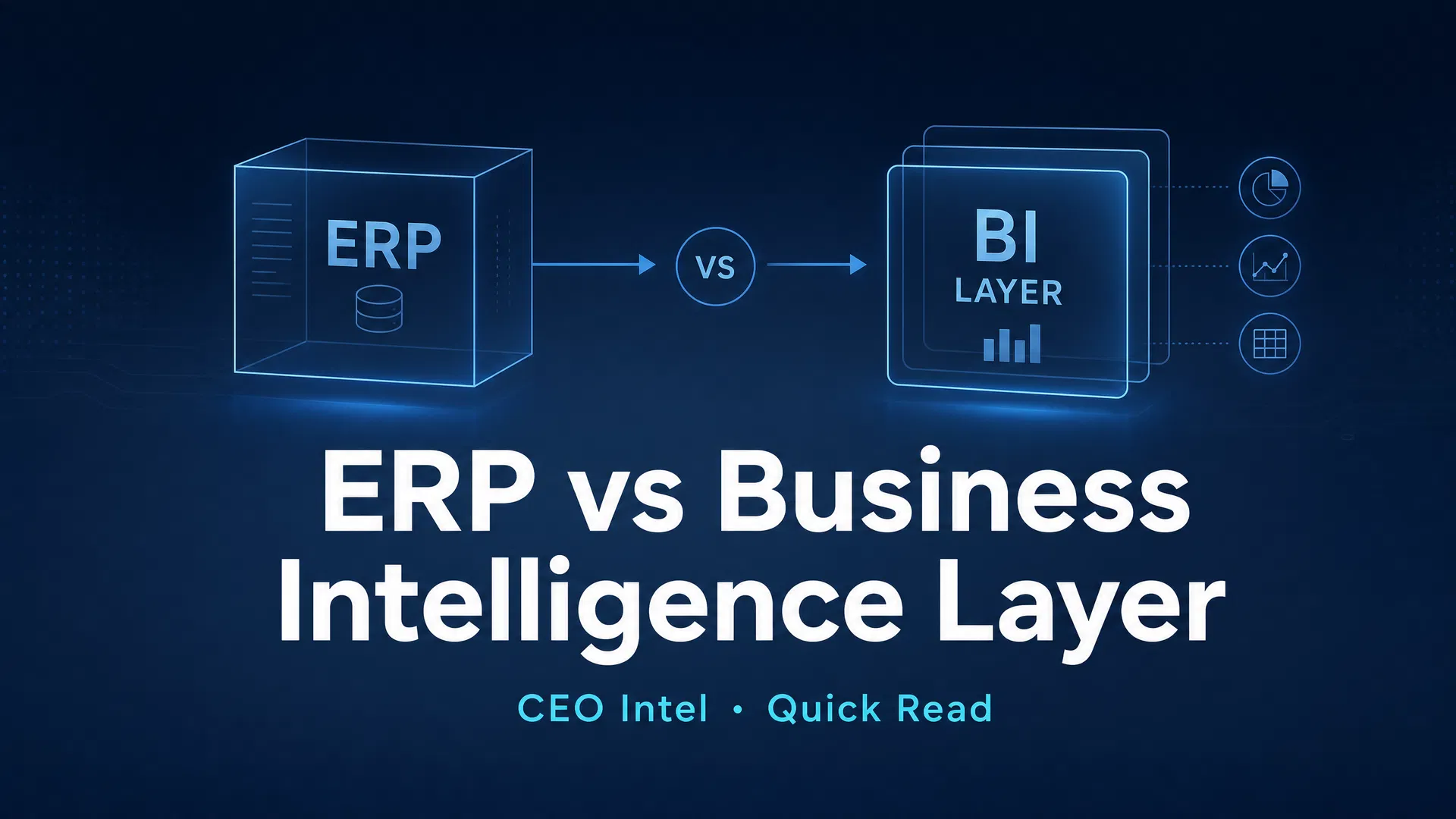
The short answer: an ERP is built to run your business, while a business intelligence layer is built to help you see it. An ERP processes the day-to-day work — orders, inventory, transactions. A business intelligence layer sits above the ERP (and your other systems) and turns what they all contain into a clear picture you can understand and act on. They do different jobs, and most companies need both.
Here is the distinction in more detail.
What an ERP does
An ERP (Enterprise Resource Planning system) is operational software. Its job is to run core business processes and keep them consistent. A typical ERP handles things like order processing, inventory and procurement, production planning, and accounting entries. It is where work actually gets done and recorded.
An ERP is built for the people performing those tasks — the purchase team, the production planner, the accounts clerk. It is excellent at keeping operations running in an organised, repeatable way. It is not primarily designed to give the business owner a single, plain-language answer to “how is the whole company doing right now?”
What a business intelligence layer does
A business intelligence layer is built for seeing, not running. Instead of processing transactions, it reads across the systems that already hold your data — the ERP, your accounting software, spreadsheets, your CRM — and assembles that information into an understandable picture.
A business intelligence layer is built for decision-makers rather than task-performers. Its job is to answer questions, reveal trends, highlight what needs attention, and support decisions. Crucially, it does not replace the ERP — it depends on the ERP and other systems as sources of the data it interprets.
The key differences at a glance
Purpose: an ERP runs operations; a business intelligence layer interprets data for decisions.
Primary user: an ERP serves task-performers in each department; a business intelligence layer serves owners and managers who need the whole view.
Direction: an ERP records what is happening as work is done; a business intelligence layer looks across everything to show what it means.
Relationship: a business intelligence layer sits above the ERP and reads from it — the two are complementary, not competing.
Do you need both?
In most mid-sized companies, yes. The ERP keeps operations running. The business intelligence layer turns the data those operations generate — together with data from every other system — into something the owner can actually use to make decisions.
A common point of confusion is that some ERPs include built-in dashboards or reporting modules. These are useful, but they typically show only the data held within that ERP, and usually present what has already happened. A dedicated business intelligence layer is designed to read across all of a company’s systems — not just the ERP — and to surface what needs attention going forward, which is why the two are not interchangeable.
A note on “CEO intelligence systems”
A CEO intelligence system is a specific kind of business intelligence layer, designed around the owner’s needs in particular. In addition to assembling the full picture, it actively surfaces early warnings and opportunities, lets the owner ask questions in plain language, and recommends actions — focusing on what an owner needs to know and decide, rather than on general-purpose reporting.
Part of Manufacturing Week. Related: What Is a CEO Intelligence System? For the fuller story, read Seven Systems, Zero Answers: The Manufacturing Data Trap.