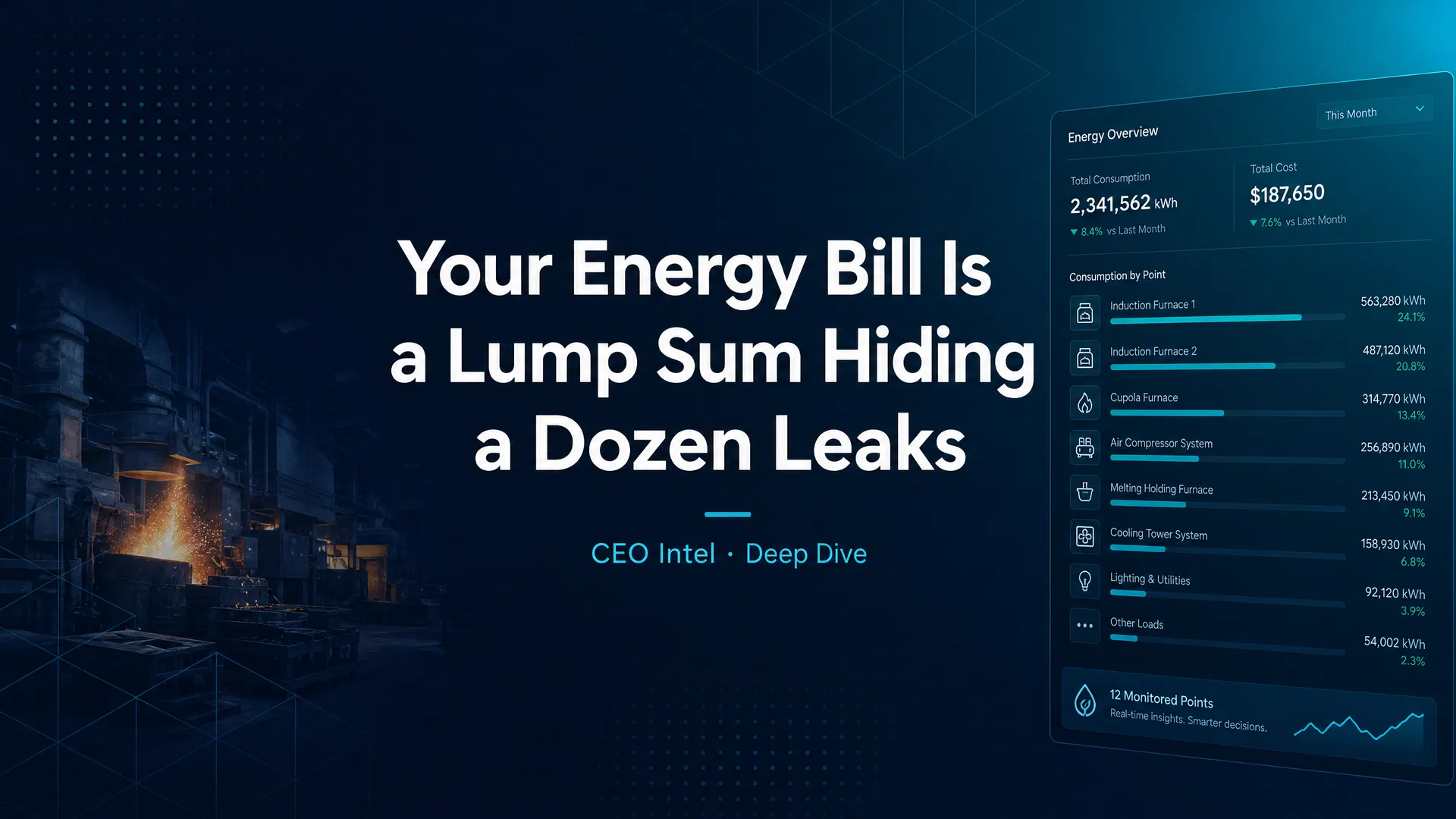
Your Energy Bill Is a Lump Sum Hiding a Dozen Leaks
By Nevil Darukhanawala | Series: Forging & Casting Week
Every month, the energy bill arrives. For a forging or foundry business it’s a big number — one of the largest costs you carry after the metal itself — and you pay it the way you’ve always paid it: as an unavoidable, lump-sum cost of running furnaces hot and melting metal. You might glance at whether it’s up or down on last month, sigh either way, and move on. There’s nothing else to do with it, because it’s one total figure for the whole operation. That single number is the entire visibility most forging and foundry owners have into their second-largest cost. And inside that one lump sum, a dozen separate leaks are hiding, each one invisible precisely because they’re all melted together into a single figure you can’t take apart.
This is the strange thing about energy in your business. You run one of the most energy-intensive operations in all of manufacturing, and you see that enormous cost only as a monthly total — never connected to the parts it made, the furnaces that consumed it, or the waste it was lost to. You’d never run your metal cost that way. You’d never accept a single monthly “metal bill” with no idea which products consumed it. Yet that’s exactly how nearly every forging and foundry operation runs its energy.
What a single number can’t tell you
A lump-sum energy bill answers one question — how much did we spend — and hides every question that actually matters. Consider what you can’t see inside that one figure.
You can’t see your energy cost per part or per tonne, so you don’t know whether the energy going into a given product line is in line with what you quoted, or quietly eating the margin. You can’t see which furnace or process is consuming disproportionately — whether one ageing furnace is burning far more power per tonne than the others and silently dragging your costs up. You can’t see how much energy is being burned on parts that end up rejected — energy spent to manufacture scrap, a double loss that compounds your rejection cost. You can’t see waste from furnaces held hot while waiting for work, or from inefficient loading, or from running below efficient capacity. And you can’t see trends — whether your energy intensity is creeping up over months in a way that signals a developing problem, because each month’s bill is just a number you compare loosely to the last.
Every one of those is a real, separate leak. Every one of them is buried in the same monthly total, indistinguishable from legitimate, productive energy use. So you pay the bill, note that energy is “expensive,” and never get to ask the questions that would actually reduce it — because the one number you’re given can’t be asked.
Why this is a visibility problem, not an energy problem
It’s tempting to think the answer to high energy cost is operational — better furnaces, off-peak running, efficiency projects. Those help. But you can’t manage what you can’t see, and the first problem isn’t that your energy use is necessarily inefficient — it’s that you have no way to know where it’s inefficient, because the cost is never broken down. You can’t fix the furnace that’s consuming disproportionately if you don’t know which one it is. You can’t stop burning energy on rejects if you can’t see how much of your power is going into scrapped parts. You can’t address the cost of furnaces held hot if that waste is invisible inside the total.
The data exists. Your energy is metered. Your production is recorded. Your rejects are logged. The connection between energy consumed and parts produced — the thing that would turn a lump sum into a per-part, per-furnace, per-product picture — is entirely makeable. It just isn’t made, because the energy meter, the production record, and the quality data live in separate places and nobody assembles them into the one view that would reveal where the energy actually goes. So your second-largest cost stays a black box, and the dozen leaks inside it stay invisible.
What walking in knowing means for your energy
Now imagine seeing it. Your energy cost broken out — per part, per tonne, per furnace, per product line — kept current, instead of arriving once a month as one undifferentiated number. Suddenly the black box becomes a map of where your money is going.
You’d see that one furnace is consuming meaningfully more energy per tonne than its peers — a maintenance or efficiency problem you can now actually locate and address. You’d see how much energy is being burned on rejected parts, which sharpens the true cost of your rejection rate and tells you exactly what your quality problems are costing you in power alone. You’d see which product lines are energy-heavy enough to be quietly unprofitable at the price you quoted. You’d see the waste from furnaces held hot waiting for work, and be able to schedule against it. You’d see your energy intensity trending over time, early enough to catch a developing problem before it shows up as a shockingly high bill.
This is what walking in knowing means for a forging or foundry business’s energy. Not an efficiency consultant, not a capital project — just being able to see your second-largest cost broken into its real parts, so the leaks that hide inside the monthly lump become specific, locatable, and fixable. The information was always there in your meters and your production records. The only thing missing was assembling it into a picture you could actually read and act on.
Why this matters more than owners assume
In a business where energy is one of your two largest costs, the difference between a tightly-managed energy profile and a loose one is not marginal — it’s a large amount of money, every month, compounding across the year. And because energy waste is invisible inside a lump sum, it’s the kind of cost that drifts upward unchecked: a furnace slowly degrades, a process gets less efficient, rejects rise and take more energy with them, and none of it is visible until it’s baked into a permanently higher bill that nobody can quite explain.
Seeing your energy clearly is how you stop that drift — how you catch the degrading furnace, the energy bleeding into rejects, the product line that’s quietly unprofitable on power alone, while you can still act. It’s one of the highest-return forms of visibility in the entire business, precisely because the cost is so large and so completely hidden inside a single number that you’ve never been able to question.
The takeaway
Your energy bill is a lump sum, and a lump sum is the enemy of management. One number for your second-largest cost tells you how much you spent and nothing about where it went — and inside that number, a dozen separate leaks hide in plain sight: the disproportionate furnace, the energy burned on rejects, the unprofitable product line, the furnaces held hot, the slow upward drift. None of them can be fixed while they’re invisible, and all of them are invisible while energy is one figure.
Break the lump sum into its real parts — per part, per furnace, per product — and your largest hidden cost becomes a map of recoverable money. In a business this energy-intensive, that’s not housekeeping. It’s one of the most direct ways to improve what the business earns, hiding the whole time inside a bill you pay without ever being able to read.
Part of the Forging & Casting series. Start with You Pay to Make Every Part Before You Know If It’s Good Related: The Reject You Paid Full Price to Make.
— BODY ENDS —