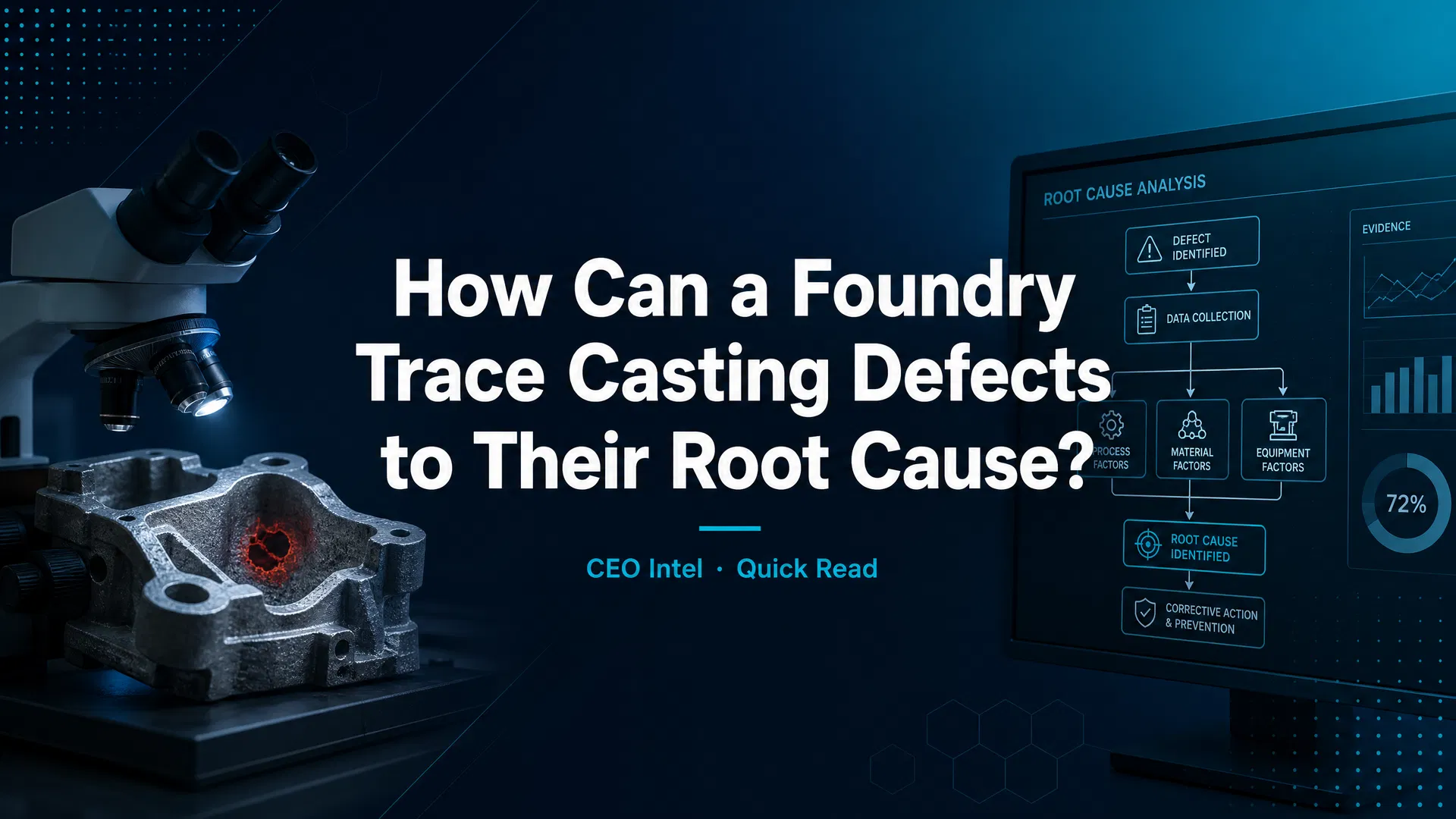
How Can a Foundry Trace Casting Defects to Their Root Cause?
By Nevil Darukhanawala | Series: Forging & Casting Week
A foundry can trace casting defects to their root cause by connecting each defective batch’s inspection result back to the data that produced it — the melt chemistry, process parameters, furnace, die or mould, shift, operator, and alloy — so that recurring defects can be linked to a specific, fixable cause. Defect traceability is the ability to follow a quality failure back through the production record to what caused it, and it is what turns a recurring reject from an unavoidable cost into a problem that can be stopped.
This matters because casting and forging defects are usually process-driven, so a defect whose cause is not identified tends to recur, costing the business batch after batch.
Why defects recur without traceability
A defect such as porosity, inclusion, or a dimensional error has a cause — in the melt, the pouring, the mould condition, a specific furnace, or a process parameter. Identifying that cause requires connecting several records for the specific failed batch. In most foundries these records are separate: inspection results in quality, melt chemistry in the lab, process parameters on the floor, and batch details in production. Connecting them manually under production pressure rarely happens, so the cause is never isolated and the same defect appears again.
What root-cause tracing requires connecting
Inspection results — what failed, and how.
Melt chemistry — the composition of the specific heat.
Process parameters — pouring temperature, timing, and other settings.
Equipment data — the specific furnace, die or mould, and its condition.
Production context — shift, operator, alloy, and batch.
When these are linked for a failed batch, patterns become visible: a grade that rejects high, a die producing more defects as it wears, a furnace that drifts, or a shift that correlates with failures.
Why this is hard today
The obstacle is fragmentation. The data needed to trace a defect exists but lives in separate systems and formats, so assembling it for a specific batch is slow manual work that production pressure usually prevents. As a result, defects are logged and remelted, but their causes go unexamined.
How it is done effectively
To trace defects to root cause, a foundry connects its quality, lab, process, and production data so that any defective batch can be followed back to the conditions that produced it, and recurring causes can be identified across batches. This is the kind of capability a CEO intelligence layer provides: linking the scattered records into one view where defect patterns and their causes become visible.
Tracing defects this way lets a foundry identify and fix the recurring causes of rejection — the problem grade, the worn die, the drifting furnace — so the same defect is not produced and paid for repeatedly, improving quality and margin on every future batch.
Part of the Forging & Casting series. See the fuller story in The Reject You Paid Full Price to Make. Related: What Is a Cross-Functional Business Alert?
— BODY ENDS —