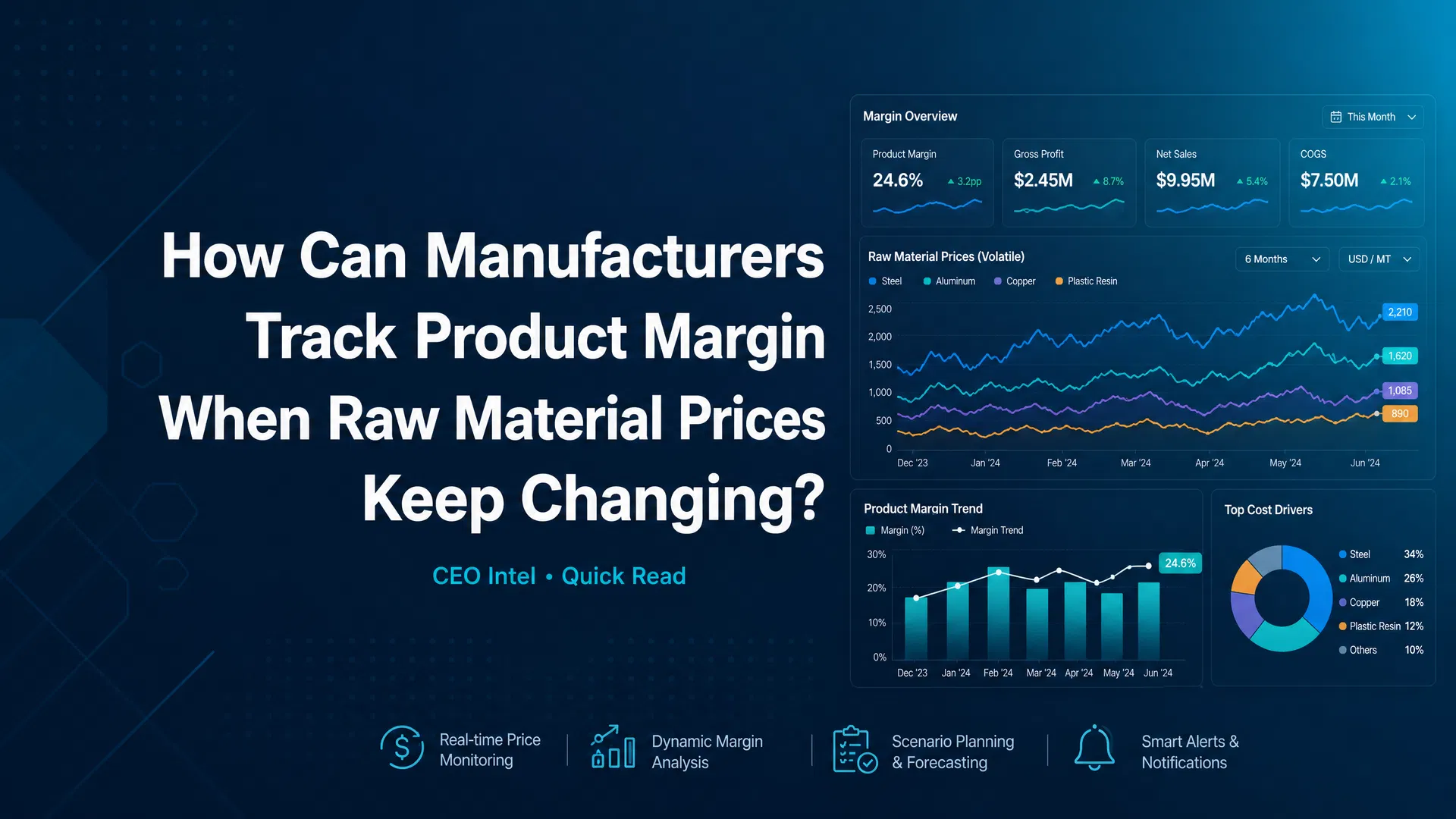
How Can Manufacturers Track Product Margin When Raw Material Prices Keep Changing?
By Nevil Darukhanawala | Series: Plastics Week
Manufacturers can track product margin under changing raw-material prices by connecting their current material costs to their selling prices for each product, so that margin is recalculated as input prices move — rather than discovered only at month-end. Real-time product margin is the current profitability of each product given today’s material cost, and tracking it matters most where raw material is the dominant cost and its price is volatile, as in plastics and injection moulding.
This matters because when material prices move but selling prices are fixed, a product’s margin can erode invisibly between price revisions, and the loss is only seen at month-end if margin is not tracked continuously.
Why fixed selling prices and volatile material costs create hidden risk
In many businesses, raw material — such as polymer resin — is the largest part of product cost, while the selling price agreed with the customer is fixed for a period. When the material price rises, the margin on every unit sold falls, but nothing on the floor signals it. The product keeps being made and shipped at an eroded margin until a month-end review reveals soft profitability, by which point the affected orders have already shipped.
What tracking margin in real time requires
Current material costs — up-to-date purchase prices for each grade of raw material.
Per-product material consumption — how much material each product uses.
Selling prices — the current price agreed for each product.
Continuous recalculation — margin updated as material prices change, by product.
Together these show which products are still profitable at today’s prices and which have drifted toward or into loss.
Why it is usually invisible
The data needed is scattered: purchase prices in accounting, consumption in production, and selling prices in sales records. Because these are not connected and recalculated as prices move, margin is only assembled at period-end, too late to act on the products that have eroded.
How it is done effectively
To track margin in real time, a manufacturer connects purchasing, production, and sales data so that each product’s margin is recalculated as material prices change. This is the kind of capability a CEO intelligence layer provides: combining current costs and prices into a live margin view by product, rather than a month-end report.
Tracking margin this way lets a manufacturer see which products have eroded as material prices moved, act early — through customer price revisions, purchasing decisions, or product focus — and protect margin while orders can still be influenced, rather than absorbing the loss after the period closes.
Part of the Plastics & Injection Moulding series. See the fuller story in The Quote You Won at Last Month’s Resin Price and Your Margin Moves Every Day With the Resin Price. Can You See It?
— BODY ENDS —