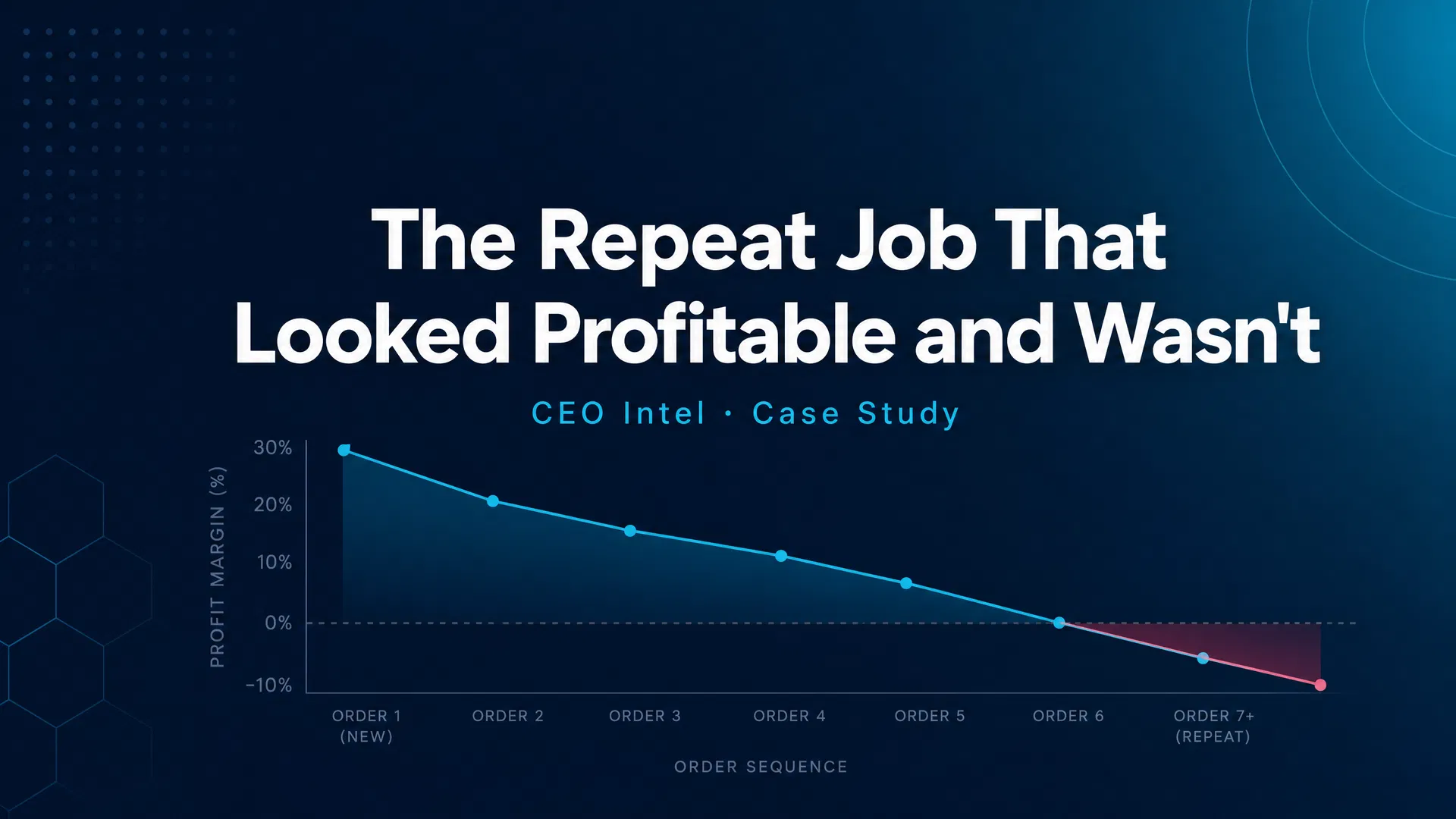
The Repeat Job That Looked Profitable and Wasn’t
By Nevil Darukhanawala | Series: Sheet Metal Week
Sameer runs a sheet-metal fabrication business in the Rabale industrial area in Navi Mumbai — around ₹35 crore, a couple of fibre lasers, press brakes, a welding section, the kind of fab that does a healthy mix of repeat production work and one-off jobs. He’s a hands-on owner, knows his customers, knows his floor. If you’d asked him which of his jobs made money, he’d have given you a confident answer based on years of instinct. And on most jobs, his instinct was right.
I’m telling his story because of one job — a steady, high-volume repeat job he’d have sworn was one of his best — that turned out to be quietly losing him money on every single run, for a reason he simply couldn’t see.
The situation
The job was a bread-and-butter product for Sameer: a sheet-metal enclosure he made in volume for a long-standing customer, week in, week out, in steady quantities. It was exactly the kind of work a fabricator likes — predictable, repeat, a reliable customer, a full order. Sameer thought of it as a cornerstone job, one of the reliable earners that kept the floor loaded. There was no reason to question it. The customer was happy, the parts shipped on time, the invoices were paid. By every signal Sameer could see, it was a good job.
What he couldn’t see was the yield. This particular part nested poorly on the sheet — the geometry left a lot of awkward offcut around each piece — and on top of that, the way it had been programmed years ago, when the job first started, was never revisited. So every run was turning a much smaller share of each sheet into product than it should have, and throwing the rest into the scrap bin. The material waste on this one job was running well above the floor average. But because all the scrap from the whole floor went into one pile, weighed and sold together, the waste from this job was completely camouflaged. It vanished into the general scrap figure, and the job looked exactly as profitable as Sameer assumed it was.
Why it stayed invisible
It’s worth being fair about why an experienced owner like Sameer missed this. The job was genuinely good in every way he could observe: steady volume, reliable customer, on-time delivery, prompt payment. The one thing wrong with it — its poor material yield — was invisible by every normal means, because scrap on a fabrication floor is almost never traced back to the job that created it. It’s weighed as a single pile and sold. So a job quietly wasting fifteen points more material than it should looked identical, in every report and every glance at the floor, to a job running clean. The loss was real and recurring, but it was perfectly hidden inside a number Sameer had long since stopped questioning.
And because it was a repeat job, the loss compounded. This wasn’t one bad run — it was the same quiet waste, every week, for years, on a job everyone considered a cornerstone. The better the job looked, the less anyone thought to examine it.
What changed
When Sameer brought his business into a unified view — one that tracked material yield by job, tracing what each job actually turned into product versus scrap — this job stood out immediately. Not because anyone suspected it, but because once yield was visible per job, the gap was impossible to miss: this cornerstone product was yielding far below the floor average, quietly consuming far more steel per part than its peers.
The figure that landed: across a year of steady runs, the poor yield on this one job was costing Sameer a little over ₹14 lakhs in wasted material he’d been treating as an unremarkable part of the general scrap pile. Not lost to any disaster — just quietly fed into the bin, a few square inches of every sheet at a time, on a job he’d have defended as one of his best.
What he did with it
The fix, as usual, was completely ordinary once the problem was visible. Sameer had his programming team revisit the nesting on that part — work that, years earlier, had been set up once and never touched. A better nest fitted more parts per sheet and cut the offcut substantially. They made a small adjustment to how the job was run. Within a couple of weeks, the job’s yield had climbed close to the floor average, and a job that had been quietly bleeding ₹14 lakhs a year of material was now earning what Sameer had always believed it earned.
More importantly, with yield now visible by job, he found two more repeat products with the same hidden problem — caught early this time, fixed before they cost another year of waste. The cornerstone job he’d never have thought to question turned out to be the one most worth examining, precisely because its size meant its hidden waste was the largest.
Why this is the opportunity side of the same coin
What’s worth understanding is that this is the opportunity side of seeing your material clearly. The same visibility that warns you about a rising scrap rate or a machine drifting out of calibration also reveals the profit hiding inside a job you assumed was fine. Sameer didn’t find a new customer or win new work. He found margin that was already there — already inside his existing business, on a job he was already running — simply waiting to be seen. The ₹14 lakhs wasn’t new revenue. It was profit he’d been making and immediately throwing away, recoverable the moment he could see where it was going.
The takeaway
Sameer’s cornerstone job looked profitable, and on every visible measure it was. The one thing wrong with it — that it turned too little of each sheet into product — was invisible, because its waste disappeared into a scrap pile no one traced back to source. The opportunity wasn’t out in the market. It was sitting inside a job he ran every week, in margin he was making and discarding without ever knowing.
That’s the opportunity side of seeing your whole business clearly. Not just catching what’s going wrong, but uncovering the profit you’re already leaving on the floor — on the jobs you’d least think to question, because they look like your best. In a business where the material is the margin, the job worth examining most is often the busy, comfortable one you’ve stopped looking at.
Part of the Sheet-Metal Fabrication & Laser Cutting series. This is the idea from The Margin You’re Throwing in the Scrap Bin shown in practice — and the fabrication cousin of The Reorder That Almost Didn’t Happen.
— BODY ENDS —